
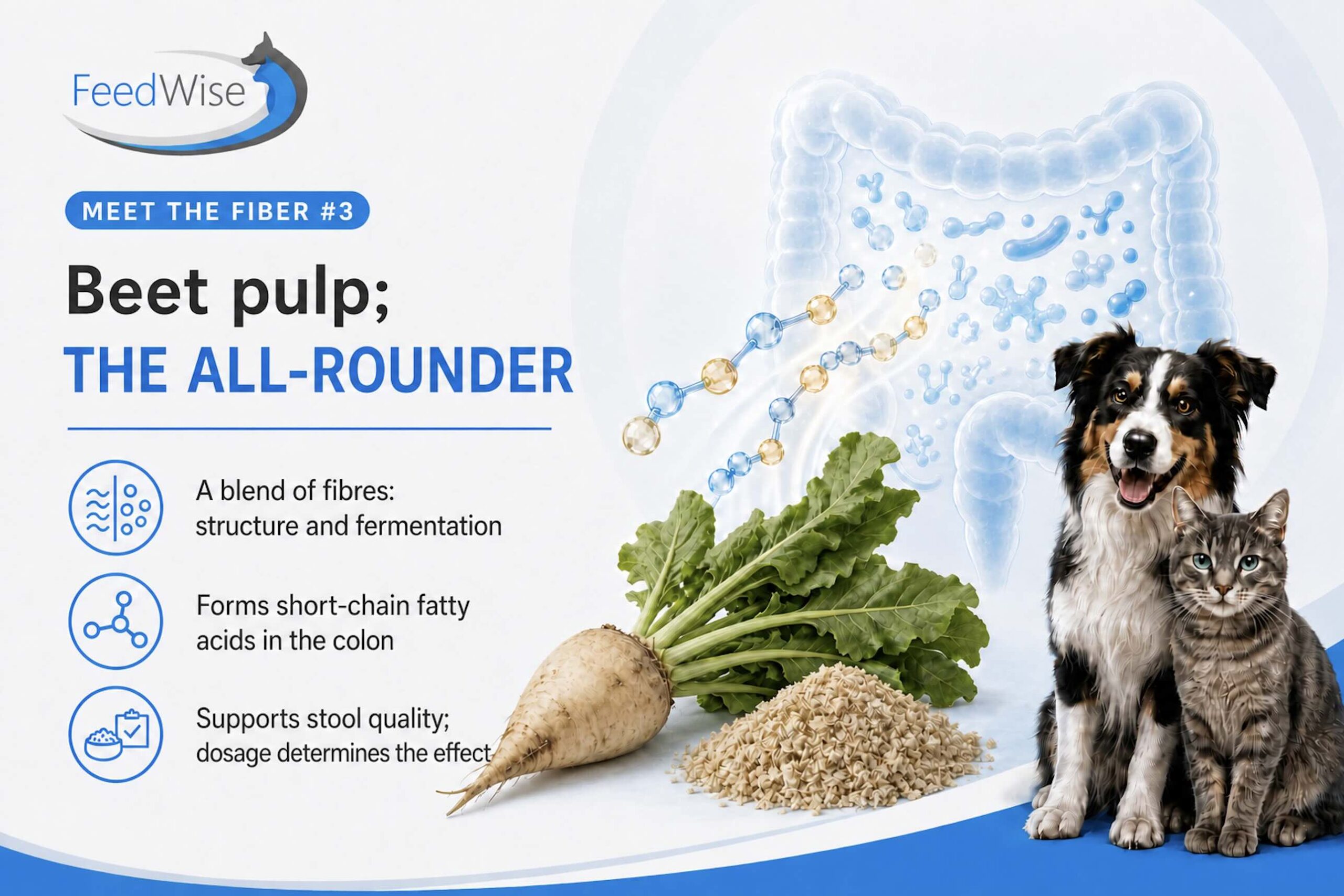
Beet pulp. For some owners, the name alone is enough to raise objections.
“A cheap by-product.”
“Nothing but a filler.”
“Indigestible, and therefore bad for the gut.”
It is sometimes even claimed that beet pulp irritates the intestinal wall or disrupts the microbiome. There is no sound basis for such sweeping statements.
What is beet pulp, exactly?
Beet pulp is the fibre-rich fraction that remains after the sugar has been extracted from sugar beet. Most of the extractable sugar has therefore already been removed. What is left consists mainly of various structural carbohydrates, including pectin, hemicellulose and cellulose.
It is precisely that combination which makes beet pulp an all-rounder.
Psyllium stands out above all for its water-binding capacity. FOS is rapidly fermentable and serves as a food source for specific gut bacteria. Beet pulp sits somewhere in between.
Part of it is fermented by bacteria in the large intestine. This produces short-chain fatty acids, which play a role in the intestinal environment and can serve as an energy source for intestinal cells.
Another part remains intact for longer and contributes to the volume and structure of the intestinal contents. In that way, beet pulp can help support good faecal quality.
So is beet pulp always beneficial?
No. As with any fibre, the dosage, processing, overall fibre mix and the patient determine the final effect. At high inclusion levels, faecal output may increase and the apparent digestibility of nutrients may decrease. That does not make beet pulp harmful. Above all, it shows that more fibre is not automatically better.
The fact that beet pulp is not fully digested by the animal itself does not make it a mere filler. A fibre passing through the small intestine largely undigested is exactly what is needed for it to provide structure in the large intestine or to be used by gut bacteria. The presence of beet pulp on the ingredient list is therefore no reason to reject a diet.
The practical assessment happens elsewhere: look at the patient and at the stools. Are the faeces well formed, is the volume acceptable and are there no complaints such as excessive gas? Then the fibre profile is probably a good fit.
Are there large volumes or loose stools, flatulence or a higher defecation frequency? Then assess the total amount and combination of fibres, rather than just the word ‘beet pulp’ on the label.
In short: don’t only look at the bag of food, but also at the stools. That is where you see whether this all-rounder is doing its job well.
🥣 Meet the Fiber: a FeedWise series on dietary fibre in dogs and cats. Each edition covers one fibre: its mechanism of action, indications, limitations and place in clinical practice.
Next edition: cellulose, the stimulator.
No responses yet