
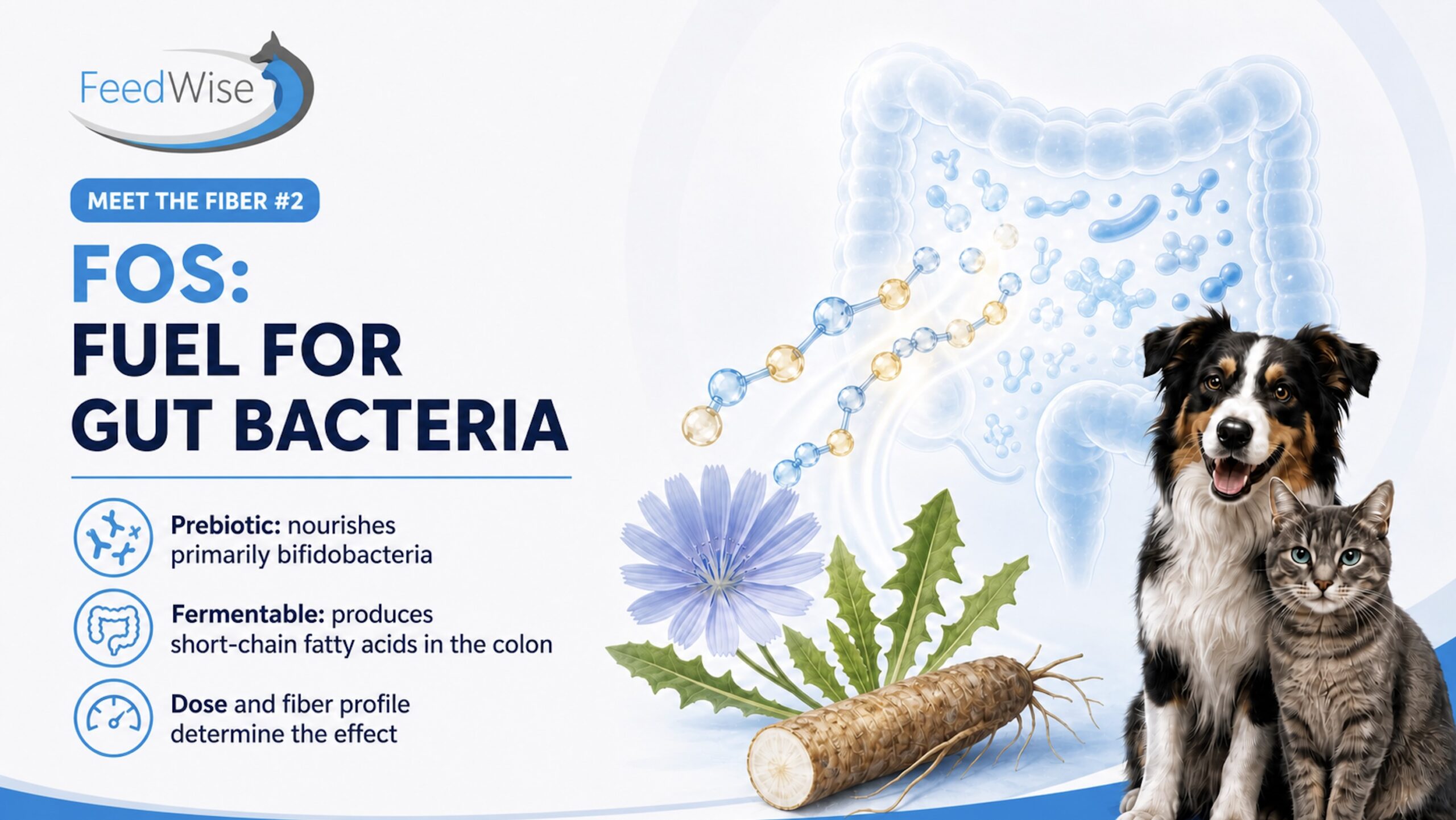
In the previous edition of Meet the Fiber we discussed psyllium, which mainly binds free water in the gut and thereby shapes what the faeces look like. FOS works along a different route: it does not feed the animal itself, but the bacteria in its colon.
FOS stands for fructo-oligosaccharides: short chains of fructose molecules strung together. You probably know the longer variant as inulin. Dogs and cats lack the enzymes to break down these fructose chains, so FOS passes through the small intestine virtually untouched and arrives intact in the colon. There it is fermented (broken down and used as an energy source), mainly by bifidobacteria.
What does the animal gain?
Fermentation of FOS produces so-called short-chain fatty acids. Butyrate is the most important of these and is a key fuel for the cells of the intestinal wall itself. In addition, the composition of the gut flora shifts, because bacteria that can break down FOS multiply faster. The acids released during this breakdown also lower the pH, which is less favourable for a number of undesirable bacterial species. There are also indications that short-chain fatty acids positively influence barrier function and local immunity, although this is less well substantiated in dogs and cats.
That makes FOS a prebiotic: a fibre that selectively feeds certain gut bacteria and thereby provides the animal with a demonstrable health benefit.
🩺 When is FOS useful?
FOS is not a treatment for a specific condition, but a building block in the fibre strategy of a ration. It comes into play when you want to influence fermentation in the colon, not when you mainly want to adjust faecal structure. That is precisely the distinction with psyllium.
In practice you think of FOS in animals with recurrent mild intestinal complaints and variable faecal consistency, during recovery after a course of antibiotics or an abrupt diet change, and with highly digestible diets in which hardly any fermentable substrate reaches the colon. It is less obvious in an animal prone to constipation; there psyllium is the more logical choice. And in acute colitis with marked gas production, extra fermentable fibre may actually aggravate the complaints.
💡 What should you watch out for?
FOS is widely used on packaging as a marketing tool, meant to show that the food “does something for the gut”. But its mere presence says nothing. Effective amounts are small, in the order of 0.1 to 1% of the diet. If the food contains too much, the risk of gas formation, flatulence and looser faeces increases. More is therefore not always better. What ultimately matters are your patient’s complaints, the dose, and the rest of the fibres in the diet.
What to remember: you do not feed FOS to the dog or the cat, but to its gut flora. And then what counts is not so much that it is in the food, but how much, and which other components the diet contains alongside it.
🥣 Meet the Fiber: a FeedWise series on dietary fibre in dogs and cats. Each edition covers one fibre: its mechanism of action, indications, limitations and place in clinical practice. Next edition: beet pulp, the all-rounder.
No responses yet