
For many owners, freshly added meat in dry food stands for better quality and more flavour. That is why claims of 60%, 70% or even 80% fresh meat make such an impression.
But the percentage of fresh meat is not the same as the percentage of animal protein.
An illustrative calculation:
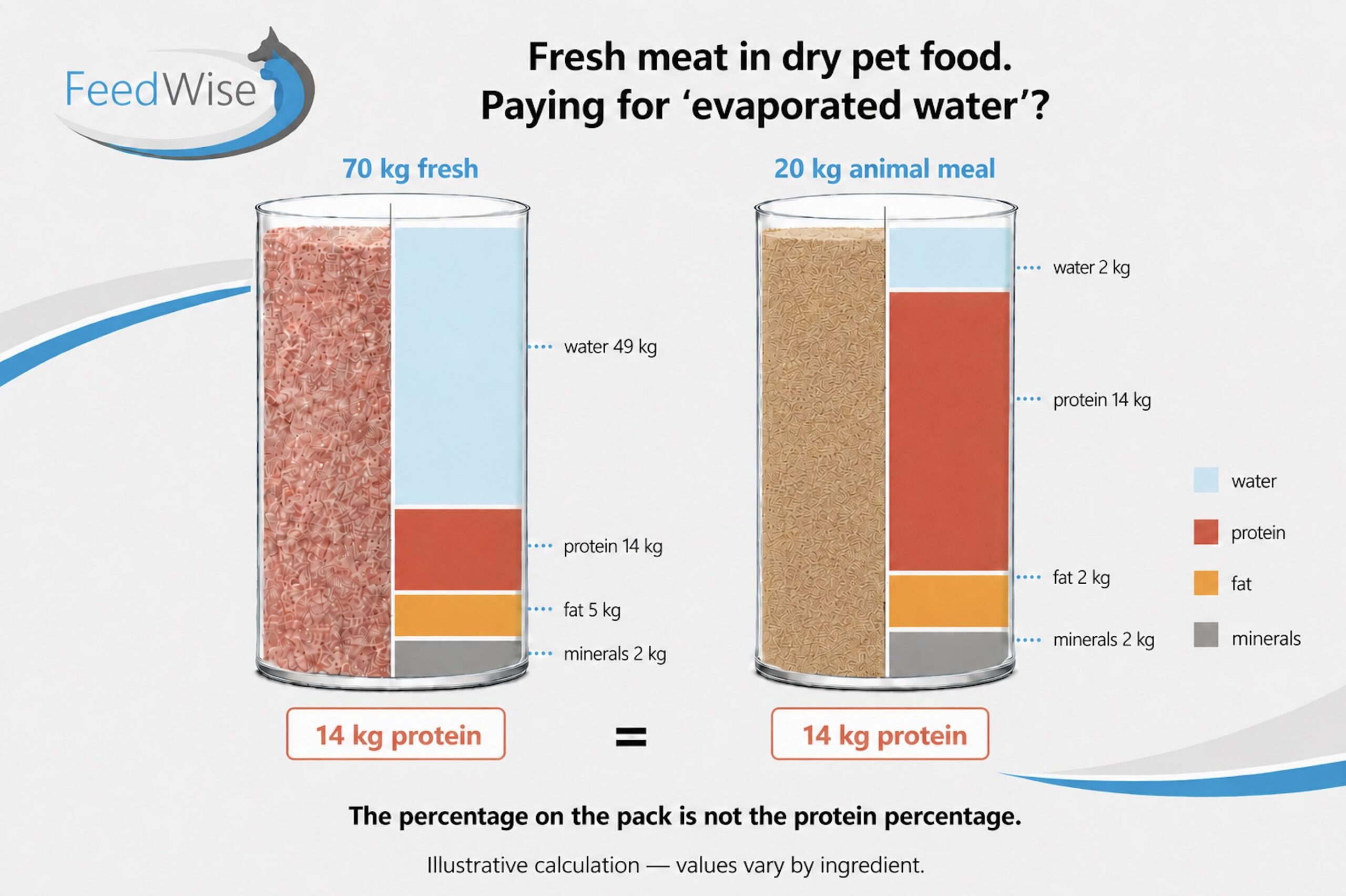
70 kg of fresh animal material containing 20% crude protein yields roughly 14 kg of protein.
Of those 70 kg, almost 50 kg may consist of water. Most of that water evaporates during kibble production.
For comparison:
20 kg of concentrated animal meal containing 70% crude protein also yields roughly 14 kg of protein.
70% versus 20% looks spectacular on a bag. The contribution to the protein content, however, can be virtually the same.
And ‘fresh chicken’ does not automatically mean whole chicken breasts go into the extruder. It usually involves finely ground chicken tissue and other usable parts from human food production.
There is nothing wrong with that: such ingredients can have perfectly good nutritional value. But fresh is not a quality mark. It says nothing about how much protein ends up in the kibble, how digestible that protein is, or how palatable the end product really is. The complete formulation and the processing determine that as well.
So the relevant question is not how much fresh meat went into the kibble.
The relevant question is how much digestible protein the finished food delivers to the animal.
#animalnutrition #petfood #veterinarynutrition #FeedWise #veterinarian #veterinarynurse
The calculation is illustrative. Moisture and protein levels differ per ingredient.
No responses yet